
Long-term strategic planning used to be straightforward. Define a vision, plot a three-year course, review annually. But when markets shift quarterly and new technology reshapes entire categories in months, a three-year plan starts to feel like a guess with a nice font.
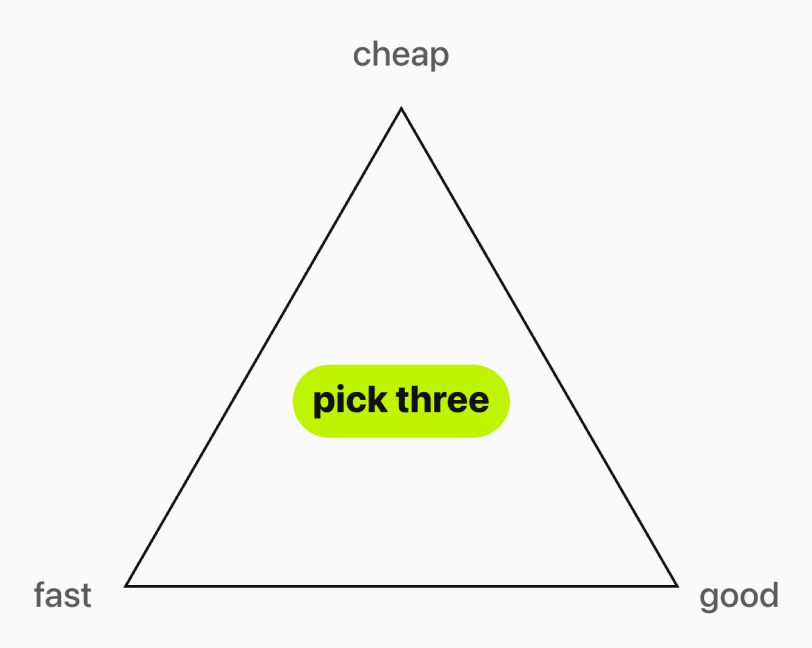
The old rule was: cheap, fast, or good. Pick two. With AI and synthetic data, that triangle is breaking. You can now get all three. But only if you change how you approach strategy.
The problem is not planning itself. The problem is that most strategic decisions are still based on remarkably little input: a handful of interviews, a competitor scan, and the opinion of whoever speaks loudest in the room. That was always risky. It is just more visible now.
What if you could test before you decide?
There is a growing body of work around synthetic user data: data generated by AI models trained on the patterns, preferences, and behaviours already present across the internet. The logic is simple: the open web contains more signal about how people think, choose, and respond than any five interviews ever will. AI can synthesise that signal into simulated respondents that mirror real-world attitudes with surprising accuracy.
This is not a replacement for talking to real people. But it is a way to pressure-test an idea before you commit budget and reputation to it. Want to know how a new positioning might land with mid-market CFOs? You can get a directional answer in hours, not weeks.
From big bets to small experiments
The shift this enables is fundamental. Instead of one large strategic cycle per year, you can run dozens of smaller tests. Validate a new product concept before building the deck. Stress-test a pricing change before the board meeting. Check whether your messaging resonates before the campaign launches.
Think of it as micro-strategy: small, fast, testable moves that stay connected to a broader vision. Each one teaches you something. Each one reduces the cost of being wrong.
The real advantage is not being smarter. It is being faster
Here is the uncomfortable truth about strategy: most organisations in the same market are looking at the same trends, reading the same reports, and using the same frameworks. The ideas are rarely the differentiator. Speed is. The organisation that tests three directions while a competitor is still debating one has a structural advantage, not because it is smarter, but because it learns faster.
That is what this approach makes possible. Not perfect predictions, but faster learning.
And in a world that changes this quickly, learning fast beats planning far.